
The AI ROI Gap: Ownership, Measurement, and Stalled Pilots
Becca Eddleman
When it comes to AI and the impact of AI on the business, there’s a massive gap between “usage” and ROI.
Industry reports show usage as high as 93% among GTM professionals, but the ROI rating is only 5-6.71% for organizations. We’ve noticed this gap in our conversations with clients and peers as well.
In a previous article, we took a deep dive into the difference between high usage and true adoption, and into what AI-assisted vs AI-integrated teams look like, based on the results of our own survey.
That’s the first part of the story. Now that we’ve differentiated these misleading statements of “we’re using AI daily” (86%) vs “our team has AI integrated into our workflows” (33%), this week, we’re interpreting the insights from the second half of our AI GTM Pulse survey covering AI pilot success and AI ROI within organizations.
Let’s say that your organization is maturing, you’re creating and testing workflows and tools, and you’re trying to integrate them into your process through real change… but you’re still not seeing ROI: pilots aren’t going anywhere past the first test.
This is when we get into why AI pilots stall, by identifying ownership, measurement, or perhaps strategy issues. We’ll cover:
- The data and the reason for the AI ROI gap
- The state of AI GTM maturity in 2026
- How to get to Stage 3 of AI GTM maturity
Survey note:
Skaled’s AI GTM Pulse survey was conducted in April 2026 to understand how GTM teams are using and operationalizing AI. In the final report, we bring those insights together, connecting the dots across usage, automations, ownership, and measurement.
See the full AI GTM Pulse results
The Data & The Reason for the AI ROI Gap
Experimentation loops have become far too common in GTM organizations. There’s early excitement from leadership and the team, and then a few things may happen that get people caught in the “loop.”
- The pilot was more complicated than expected. Deprioritized.
- The pilot is almost finished, but the input data needs to be cleaned up, so it’s not quite ready for team use. Deprioritized.
- The pilot was launched, but it only slightly improved output. ICs can do it faster the old way.
- The pilot was launched, but we forgot the point. ICs go back to doing it the old way.
Then… the next big idea comes. Same loop.
If you want to get out of this loop and see tangible ROI from your AI initiatives, you first need to identify if you’ve had one or more of these issues within your organization and AI pilots:
- No clear ownership
- No clear metrics
- Overcomplication before you’re ready
Bad data is on the list for why teams are having issues implementing AI-integrated workflows and automations, but that’s one of the easiest fixes, especially if you have the above three areas set. So in our opinion, it’s not really a blocker. Cleaning up your data is just a step in the rollout.
What stage best describes your company’s AI rollout today?

The market thinks AI adoption is further along than it actually is. Everyone says they’re “running AI pilots” and initiatives, but we’re using one word to describe completely different levels of AI GTM maturity.
A rep using chat to write emails. Pilot.
A team updating their workflow to include a GPT/Gem. Pilot.
An org testing AI automations that require little human input. Pilot.
All of these get lumped together as “pilots.” So when you hear: “80% of companies are piloting AI,” what does that actually mean?
Well, let’s break it down.
47% are mostly experimenting. 22% are automating one full process. 25% are scaling AI across 3+ workflows. Only 6% are running a structured single-workflow pilot.
When teams are “mostly experimenting,” they are in the individual experimentation phase. Individual contributors in marketing, sales, and customer success are using ChatGPT, Claude, or Perplexity for isolated tasks. Sometimes they’re prompting, maybe they’ve created their own GPTs or Gems (AI assistants), but team consistency is lagging.
Automating one full process is end-to-end orchestration that takes a complete business process and uses AI to handle or coordinate the steps from beginning to end, such as your inbound lead follow-up.
Scaling AI across 3+ workflows is three individual, smaller-scale AI-assisted workflows that may or may not be automated. For example, in the context of prospecting, your team could have built an assistant for account research, trigger-event detection, and target prioritization, but it may stop there. It doesn’t add these people to a list or populate the initial messaging, thereby differentiating these AI-assisted workflows from fully automated processes.
Piloting AI within a structured workflow is the simplest and fastest time-to-value option. Yet, only 6% are in this category. If your team is new to AI-integrated workflows, then the best option for fast results and garnering excitement is to eliminate one bottleneck first. This will set your team up for success and make adoption far smoother. This workflow can be as simple as integrating an AI assistant into a discovery meeting, which is where we usually start with companies. For example, a meeting is set, the assistant runs, your CRM is updated with relevant buyer information and an agenda for that meeting.
If your AI pilot stalled, what was the main reason?

It can be hard to hear, but most pilots fail because the team didn’t put in the upfront work, or they underestimated how much work it would take due to AI’s quick-results promise. But that’s not the story most orgs tell themselves.
We often hear, “the tech wasn’t there yet,” “it didn’t integrate well,” “it created more problems,” or “the team didn’t use it.”
In reality, what actually kills your AI pilots and initiatives has nothing to do with the tech or even low frontline buy-in.
35% of respondents in the AI GTM pulse cite no leadership push for the reason their AI pilot wasn’t successful. 32% cite poor data quality, and 24% cite a lack of success metrics to tie the pilot to.
Why are these three reasons such a big deal?
Well, when leadership isn’t on board with long-term transformation initiatives like AI, these initiatives get deprioritized the moment a quota call or budget review hits. If leadership deprioritizes, that trickles down.
In terms of poor data quality, AI amplifies what exists in your systems, meaning that if CRM hygiene is poor, pipeline data is incomplete, or contact stages vary, your outputs will never be correct. However, as we stated before, data quality should just be a part of your rollout checklist, and depending on how bad or outdated your data is, that slowdown can become a major blocker if you let it.
When an AI pilot, or any project really, doesn’t have defined success conditions, you’re going to land yourself in an experiment loop. Without metrics tied to pipeline or conversion, there’s no way to know if it’s working or to justify scaling it, and you’ll have nothing to report up.
Who owns AI initiatives inside your GTM org?

48% of GTM organizations implementing AI have no clear or multiple owners. Everyone agrees AI is a priority, but almost 50% of companies don’t have clear ownership, so what happens?
Ops thinks Sales or Marketing should drive it. Sales and Marketing think Ops should operationalize it. IT gets pulled in late to support. Leadership assumes it’s already handled.
Now we have no movement or three different directions at once, which will either conflict or double the work being done.
If ownership isn’t crystal clear from the beginning, business objectives won’t be set, pilots will be disconnected from goals, conflicting workflows and tools will emerge, and there’ll be zero accountability for how bad everything is going.
But, of course, there isn’t accountability: there is no owner. If you continue to treat AI like a side project, that’s what it will be: slow-moving and out of sight.
Here’s what we’d recommend to avoid this: an AI GTM Lead.
Appoint one AI GTM Lead who understands the strategy of the business and the complexities of AI. They’re the single owner at the top who will pull everything through. Then each department should be assigned their own lead that will report to this single AI GTM person.
It’s important that this lead understands the business goals and AI to help prioritize and navigate this transformation, much like a product roadmap. Again, AI isn’t a side project, and it’s not a one-and-done project.
Have you tied AI usage to specific metrics?

Only 17% of respondents could clearly tie AI to metrics like pipeline, conversion, or win rate.
This one is interesting. You have to ask the question: what ROI were you expecting to see when you started your AI GTM journey if you didn’t tie the initiative to metrics?
Unfortunately, many companies started with hype. You heard good things. You had quick “wins.” But what problem were you trying to solve? What bottleneck were you trying to eliminate? How much more revenue were you looking to generate in 2026?
If only 17% of people set goals, we really shouldn’t be surprised that across industries, only about 5-7% see a return on their investment.
Even if the goal is to give your reps back more time to actually sell or your marketers more time to strategize, you’ll see that return trickle down, but you have to set specific metrics.
The State of AI GTM Maturity in 2026
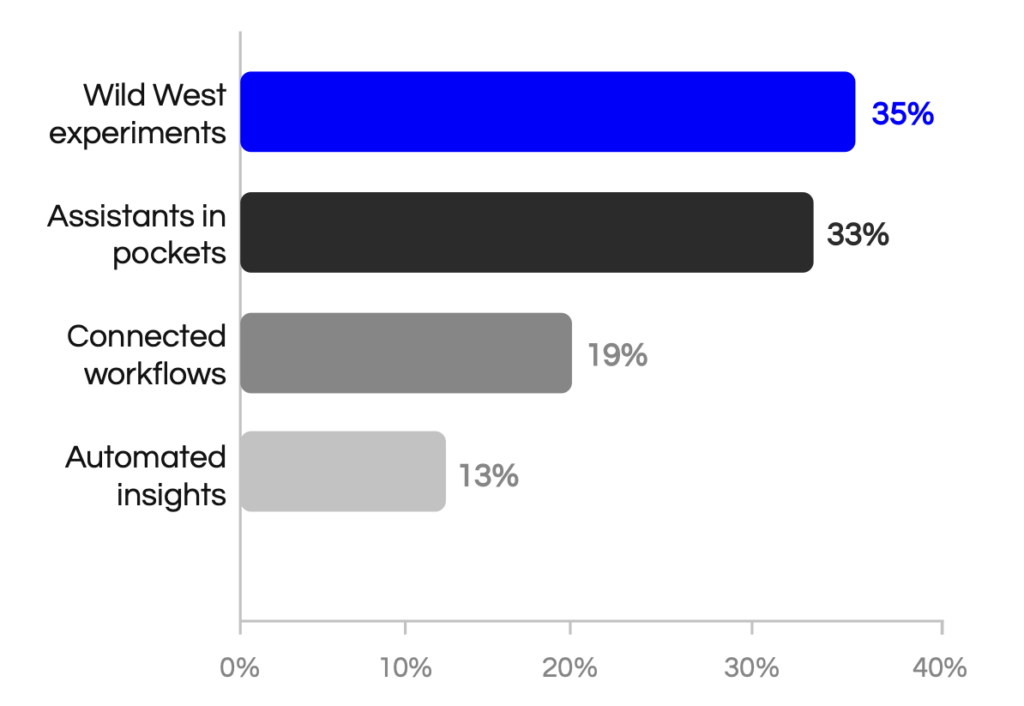
68% of companies are still in the early stages of AI GTM maturity. This means ad hoc use by individuals with varying levels of expertise in prompting have built GPTs and Gems, or maybe they’ve created their own workflows, but it very much lives in their heads and on their accounts (Stage 1 – The Wild West). If you’re one level up, your team may be using assistants consistently, but they’re not yet embedded in multi-step processes (Stage 2 – Emerging Assistants).
If this describes your company, then you’re in the majority, for now. But 33% of companies are already using embedded AI-integrated workflows and utilizing automated insights. We’d love to see this number increase by the end of 2026, but at this point, we suspect the companies in this 33% will be the ones that continue to evolve. They have their foundations built, the organization is on board, and it’s going to be easier to implement updates as AI gets better and better.
The groundsetting work is getting to Stages 2 and 3, and even though AI gets more sophisticated at higher levels of maturity, we would argue that it becomes easier to implement because the real change management is upfront: you set up your AI GTM Lead and their team, set your metrics and roadmap, clean up any excuses around bad data, and start building block on block.
What best describes your team’s AI GTM maturity today?
Wild West experiments
Ad hoc usage. Random prompts/GPTs. No governance. No repeatability
Assistants in pockets
A team may be using AI assistants (GPTs or Gems) consistently, but it’s not yet organizational or embedded in processes.
Connected workflows
AI is embedded into specific processes (prospecting, follow-ups, CRM), with consistency
Automated insights
AI is driving actions, surfacing insights, and influencing decisions across the GTM engine
Related Content: The 5 Stages of AI Maturity in GTM Organizations
How to Get to Stage 3 of AI GTM Maturity
First off, if you’re unsure what stage of AI GTM Maturity you’re in, take this assessment to know where you stand.
If you’re in Stage 1 or Stage 2 and want to level up, here’s what to do.
Going from The Wild West to Emerging Assistants
For this one, we’re going to make it super simple by giving you the criteria to set and what you should try first.
Criteria: Create one custom GPT or Gemini Gem that every person on the team will use at a specific moment, every time, in a day-to-day workflow.
Try this one for sales: Sales Call Prep
Reps rarely have enough time to prep for discovery calls. One of the best AI Assistants you can create that will make their life easier from the start is a sales call prep assistant that outputs personalized prep plans with talk tracks, questions, and materials for every meeting. All they have to do is input the company website and the buyer’s LinkedIn profile.
Bonus points if you take out the “open GPT and input information step” and automate it to automatically populate the output into your CRM.
Try this one for marketing: Creative Brief Generation
There is a lot of controversy on how well AI can write, and honestly, getting it to a good place is hard. But it’s great at research and being a thought partner. It’s also great at filling in very templatized assets – like creative briefs.
This could be a campaign creative brief or an SEO article brief. Create a GPT built on your brief template, company brand guide, do’s and don’ts, etc. Input your notes and keywords, and it will output a mostly baked brief that would previously have taken hours.
Try this one for CS: New Client Research and Prep
Pulling together call notes, thoughts, and recordings from sales on new clients can be time-consuming, even with the most detailed of sellers. Create a GPT that knows your business and your handoff process, upload the necessary call transcripts and notes, and have it output a complete prep sheet to walk into new client meetings fully informed.
You could use a standard implementation checklist for every new client, or you could personalize it and create a 6-month account plan in minutes.
Going from Emerging Assistants to Connected Workflows
This one gets a little more complicated and dependent on use case, so here’s our playbook that we use for every new AI initiative, big and small.
It’s called PLAN.
- Prioritize what matters.
- Launch fast.
- Drive adoption.
- Normalize AI in GTM.
P – You’ll start with clear prioritization based on clear use cases. Nothing fancy. Identify one repeatable workflow and build real automation, not just an AI assistant that still requires a user to prompt it with information.
- Select one team as your model.
- Select one clearly defined AI priority.
- Select one outcome that everyone agrees matters.
L – Build and launch it fast. Not for speed’s sake or the sake of getting it done. You’re building a simple but powerful AI-integrated workflow that needs to be used, tested, and iterated on.
Your model team are the ones who will get this established and rolling to keep your first pilot in a controlled setting.
- An AI-integrated workflow is actively being used by a real GTM team.
- Map early, measurable impact on productivity, or a defined metric.
A – Then you’ll focus on behavior change. That means training and reinforcement. You would never launch a new process or tool without formal training. The same goes for AI-integrated workflows, so GTM professionals understand what they do and why they will make their lives easier. Launch fast, but train and reinforce, your team will naturally give feedback or positives and negatives.
- The team manager is reinforcing AI usage across the new workflow
- You’ll start to see clear signals that AI is saving time, improving quality, or increasing consistency.
- AI stops feeling optional and starts feeling essential.
N – Last is normalization. After you see your first successful workflow flowing, teams start to get excited. They want more. Initial success and a smooth transition are essential to normalizing AI, and it will become as essential to GTM work as email, your CRM, and analytics platforms.
- From here, roll out the model team’s success across the org
- While the rest of the org is getting trained up, have your model team work on the next