
Trends Report 2025: Lessons in RevOps, AI GTM, and Outbound Shifts
Becca Eddleman
2025 marked the year B2B GTM strategy tried to catch up with how people actually buy.
The cracks in traditional go-to-market models became too big to ignore. AI moved from novelty to necessity. RevOps became a board-level discussion. Outbound was re-engineered for precision over volume. And through it all, GTM teams were forced to confront a simple truth: yesterday’s process wasn’t built for today’s buyer.
We started the year with bold predictions, but not all of them held up. Some trends accelerated faster than expected. Others stalled out or fizzled under real-world pressure. In this article, we look back at what actually happened, not just what was forecasted.
To do that, we analyzed the most widely shared insights from Jake Dunlap’s 2025 LinkedIn posts and cross-referenced them with market data from sales, RevOps, and buyer behavior studies. The goal: identify the trends that mattered, understand why they emerged, and evaluate whether they’ll carry weight into 2026.
Here’s what you’ll take away:
-
- A breakdown of which GTM trends delivered and which didn’t
- Key lessons from real-world teams, tech shifts, and strategic missteps
- Clear priorities GTM leaders should act on now, before 2026 arrives
RevOps gets a seat at the table
RevOps is finally getting the visibility it deserves.
What began as a behind-the-scenes function focused on tech stacks and reporting officially earned a strategic seat at the executive table. Investors, CFOs, and GTM leaders are now aligning around a shared goal: drive growth through operational precision, not headcount.
This shift wasn’t theoretical either. We saw PE firms updating their investments to prioritize systems over stars. And finance teams tightened efficiency metrics while operators consolidated bloated tech stacks in favor of scalable workflows. In 2025, RevOps stopped being reactive.
In the trends that follow, we break down how this shift unfolded and why it’s reshaping how GTM teams plan, measure, and grow.
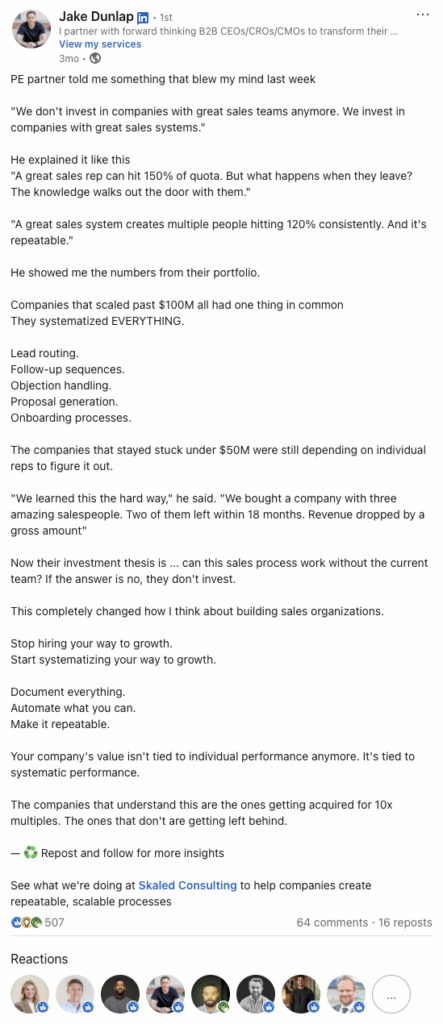
1) Systematize Your Way to Growth (PE partner POV)
PE firms are now valuing repeatable sales systems over “hero” reps. Companies that scaled past $100M “systematized everything” (lead routing, follow-ups, objection handling, proposals, onboarding). The investment test: can this sales process work without the current team?
Implications on the market:
- Enterprise value is shifting from individual performance to institutionalized GTM IP (documented playbooks, automation, and enablement tied to outcomes).
- Boardrooms and PE diligence emphasize process scalability and operational leverage, not just quota-carrying headcount.
Did this continue throughout 2025? Yes.
- CFO priorities leaned into productivity and cost discipline, not headcount growth, which validated the “systems not stars” thesis. Gartner’s 2025 CFO guidance highlights reducing costs without harming growth, and a leadership vision centered on disciplined execution. (Gartner)
- RevOps/systematization momentum increased: Outreach and other GTM leaders framed 2025 around AI copilots + collaborative GTM + coaching at scale (i.e., codifying effective behavior), reinforcing systemization over individuals. (Outreach)
Will it continue into 2026? Very likely.
- Gartner’s October 2025 CFO survey shows finance leaders entering the 2026 budget cycle balancing growth with disciplined cost management, which favors scalable systems over incremental headcount. (Gartner)
2) Stop Adding Tools to Broken Processes (Tool Sprawl vs. Process)
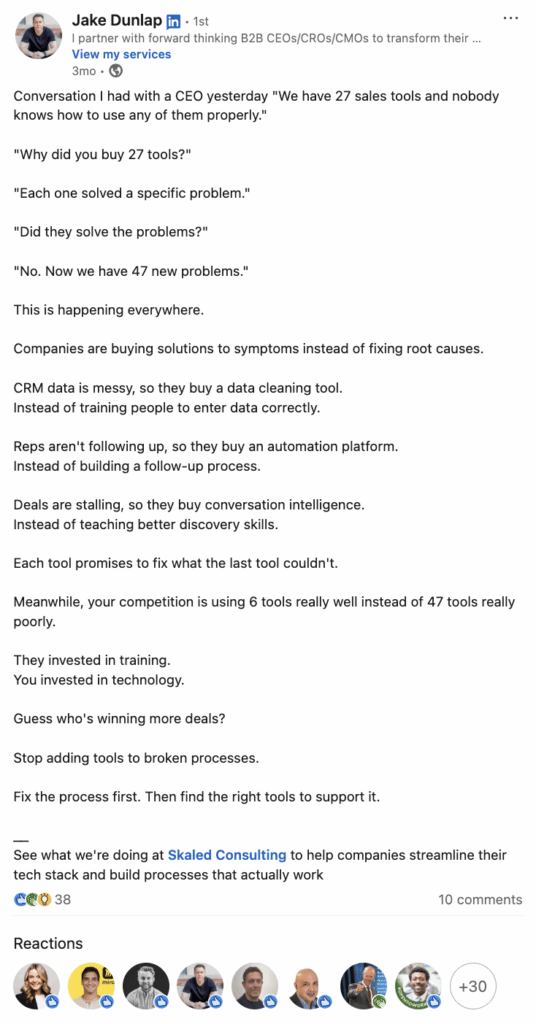
Teams should fix root-cause processes first, then pick fewer tools and use them well. “Your competition is using 6 tools really well instead of 47 poorly.”
Implications on the market:
- SaaS consolidation and license rationalization became core RevOps initiatives. Value shifts to adoption, enablement, governance, and usage analytics (not sheer app count).
- Vendors with broader platforms (suites) gained an advantage over one-feature point tools.
Did this continue throughout 2025? Strongly yes.
- Productiv reports the average SaaS portfolio fell to 342 apps (from 374) as companies consolidate into suites. (Productiv)
- BetterCloud’s 2025 State of SaaS shows 33% of orgs consolidated redundant apps, 21% reduced SaaS spend, and 63% cited unused/underutilized apps driving consolidation. (BetterCloud)
Will it continue into 2026? Yes.
- The consolidation trend is expected to continue, with portfolios shrinking and suites preferred over many point tools. (Productiv)
- Macro signals from large tech (e.g., Google’s CFO citing team consolidation for cost and speed) reinforce continued emphasis on efficiency into 2026. (Business Insider)
3) The CFO Productivity Paradigm Shift (Optimize Before Hiring)
A CFO says they budget for higher sales productivity, not more headcount. Better training, tools, and processes beat adding reps: “10-person team hitting quota beats a 20-person team missing quota.”
Implications on the market:
- Those in charge of budget (CFOs) prefer efficiency ROI (enablement, automation, data quality) to risky headcount expansion.
- Sales leaders must make productivity business cases (ramp compression, win-rate lift, CAC reduction) to unlock budget.
Did this continue throughout 2025? Yes.
- Gartner’s CFO Report (Q1 2025) centers on reducing costs without harming growth and improving data governance. A classic productivity play. (Gartner)
- The 2025 CFO leadership vision underscores disciplined execution and prioritization, echoing “optimize first.” (Gartner)
Will it continue into 2026? Yes.
- Gartner’s October 2025 survey shows CFOs entering 2026 with mandates to balance growth and cost control, which structurally favors productivity investments over net-new headcount. (Gartner)

Related Content: Should You Double Your Sales Headcount or Double Your Productivity?
4) 3 Leadership Behaviors that Kill Sales Productivity (Manage for Outcomes)
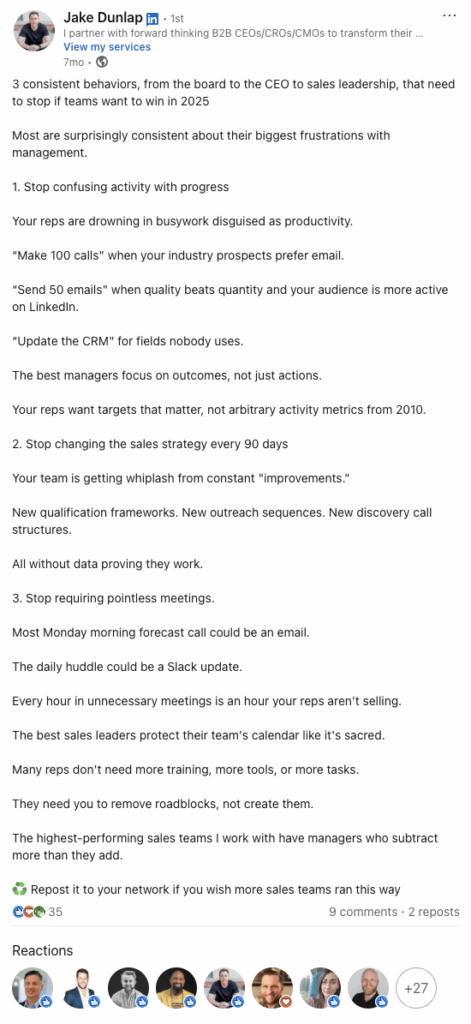
Three habits to drop: (1) confusing activity with progress (busywork, vanity metrics), (2) constant strategy changes without proof, (3) pointless meetings that steal selling time. Emphasize outcomes, data, and calendar protection.
Implications on the market:
- Expect KPIs to shift toward pipeline quality, cycle time, win-rate, and adoption metrics, with fewer activity quotas.
- Leaders must subtract (tools, meetings, steps) before they add. Calendar/meeting hygiene becomes a competitive advantage.
Did this continue throughout 2025? Yes.
- Multiple 2025 studies highlight meeting overload and wasted time, e.g., employees spend ~31 hours/month in meetings, ~50% wasted, and 72% report meeting fatigue. (ambitionsaba.com)
- Fellow’s 2025 meeting trends call out remote/async overload and the push for fewer, better meetings, aligning with the post’s thesis. (fellow.app)
Will it continue into 2026? Yes.
- As CFOs push 2026 budgets toward efficiency, orgs will continue trimming low-value meetings and activity-only metrics in favor of outcome-based management. (Gartner)
AI in sales goes from experiment to engine
In 2025, AI finally moved out of the strategy deck and into the day-to-day.
For the last few years, most sales orgs approached AI like a side initiative: vague plans, partial pilots, or a “we’ll get to it” attitude. But this year, that posture started to shift. The most forward-looking teams stopped treating AI as a long-term project and started building around it right now.
Jake’s posts highlighted exactly where this shift is starting to show up, from SDRs using AI to speed up prospecting to sales leaders confronting their own AI knowledge gaps. And while not every company has gone all-in, the market signal is clear: the window for experimentation is closing. Execution is the new expectation.
5) ChatGPT Is Not Cheating. It’s the New Google for Sellers
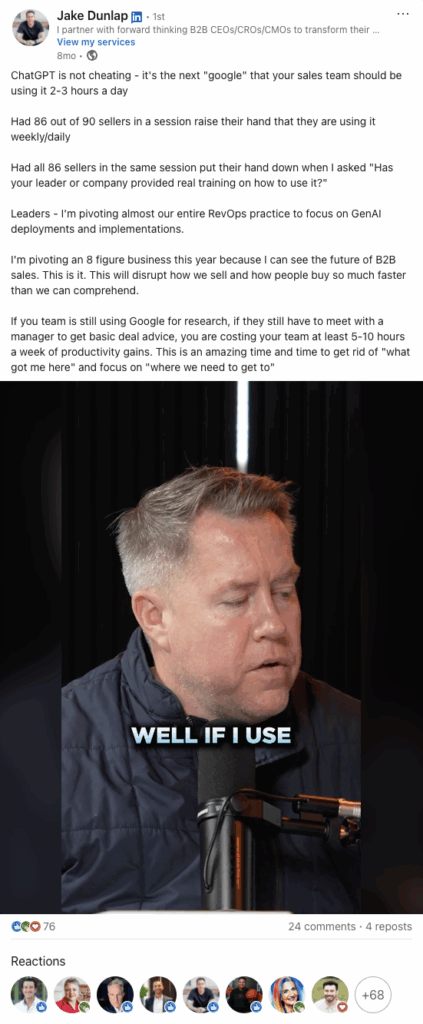
The argument: AI should be a daily habit for sellers (2–3 hours/day). In workshops, 86/90 reps used it weekly/daily, yet none had real training, a leadership and enablement gap. The call to action: pivot RevOps toward GenAI deployments, implementations, and workflow redesign to capture 5–10 hours/week of productivity per rep.
Implications on the market:
- Proficiency > access: The constraint is not in the use of tools; it’s a lack of org-level training, governance, and workflow integration.
- Budget justification should shift from “AI licenses” to documented time saved, cycle-time reduction, and win-rate lift attributable to codified AI workflows.
Did this continue throughout 2025? Yes.
- Adoption: HubSpot’s 2025 State of Sales reports that 37% of reps use AI tools (the top tool category), and AI ranks #1 in ROI. 84% say AI saves time, and 83% say it improves personalization. (HubSpot Blog)
- Value gap: Bain’s 2025 analysis calls sales a “new frontier” where agentic AI can free up selling time and raise conversion, but it requires redesign work. This echoed Jake’s point that training + workflows matter more than access to the tools. (Bain)
Will this continue into 2026? Yes. And it will normalize.
- Gartner and others forecast that 2026 CFO plans will protect margins through productivity, structurally favoring AI-driven workflow gains over headcount. (Gartner)
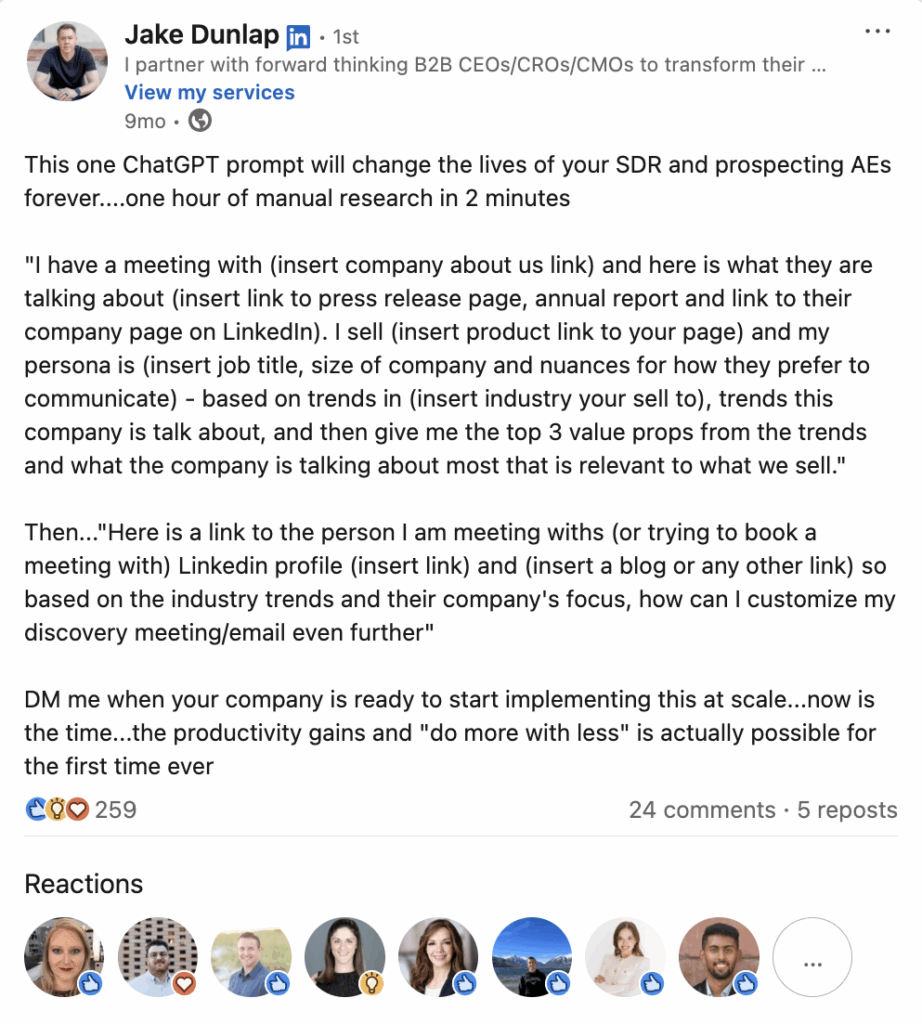
6) The ChatGPT Prospecting Prompt that Saves Hours
A repeatable research→personalization prompt can compress ~1 hour of manual research to ~2 minutes. This integrates company sources, persona details, and value props, then tailors a discovery email via the buyer’s LinkedIn profile and content. Productivity = assistant + process; though it’s not a “magic line.”
Implications on the market:
- SDR/AEs will gain leverage from standardized prompt frameworks baked into playbooks, cadences, and enablement content.
- Teams that operationalize this (knowledge docs + guardrails) can convert sporadic wins into systemic pipeline impact.
Did this continue throughout 2025? Yes.
- HubSpot 2025: AI is the most-used sales tool category: 84% cite time savings, 82% better data insights, which aligns with the research and personalization gains that this kind of prompt enables. (HubSpot Blog)
- Bain (2025) highlights agentic AI’s potential to free selling time and improve conversion when embedded into workflows, not just ad-hoc use. (Bain)
Will this continue into 2026? Yes. It will move from prompts to packaged assistants.
- Expect more codified assistants (pre-built workflows) with governance. 2026 CFO efficiency mandates will reward teams that show repeatable time-to-meeting reductions and higher conversion from AI-assisted prospecting. (Gartner)
Related Content:
A Day in the Life of an AI-Powered SaaS Seller in 2026
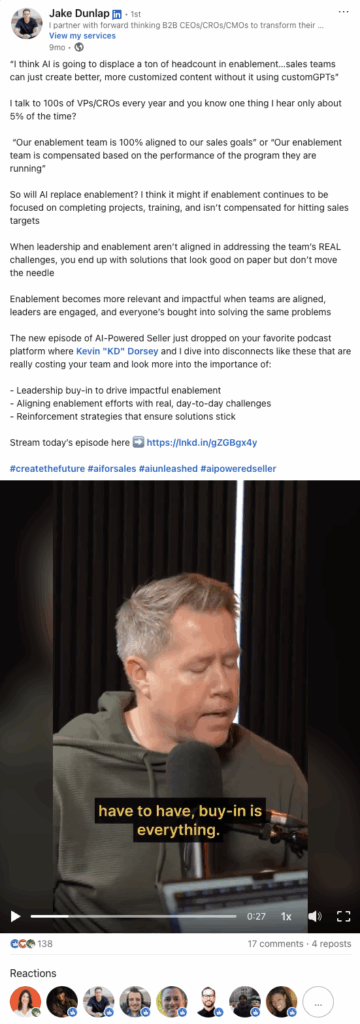
7) AI Might Replace Enablement (Unless It Evolves)
If enablement stays activity-focused (projects, content) and isn’t tied to revenue outcomes, AI-driven content and assistants will outpace it. The fix: leadership buy-in, enablement aligned with sales targets, and reinforcement to ensure solutions stick.
Implications on the market:
- Enablement must transition from a content factory to a performance function measured by ramp compression, win rate, ACV, and assistant adoption.
- Budgets consolidate under RevOps, and Enablement leaders need AI-literate curricula and measurable behavior change.
Did this continue throughout 2025? Partially. Pressure rose and maturity lagged.
- Value realization is uneven: BCG’s 2025 study finds only ~5% of companies realize measurable AI value. Winners invest in leadership engagement, workflow redesign, and upskilling—areas that effective enablement must own. (Business Insider)
- Enablement trendlines: 2025 enablement reports emphasize analytics-driven coaching and improvements in forecast accuracy via AI. These are signs of evolution toward performance, but uneven execution. (Highspot)
Will this continue into 2026? Yes. Survival will come from reinvention.
- With 2026 CFOs prioritizing margin protection and disciplined execution, enablement that proves revenue impact (not just asset creation) will gain budget. Legacy enablement will get displaced by AI-infused, outcome-tied teams. (Gartner)
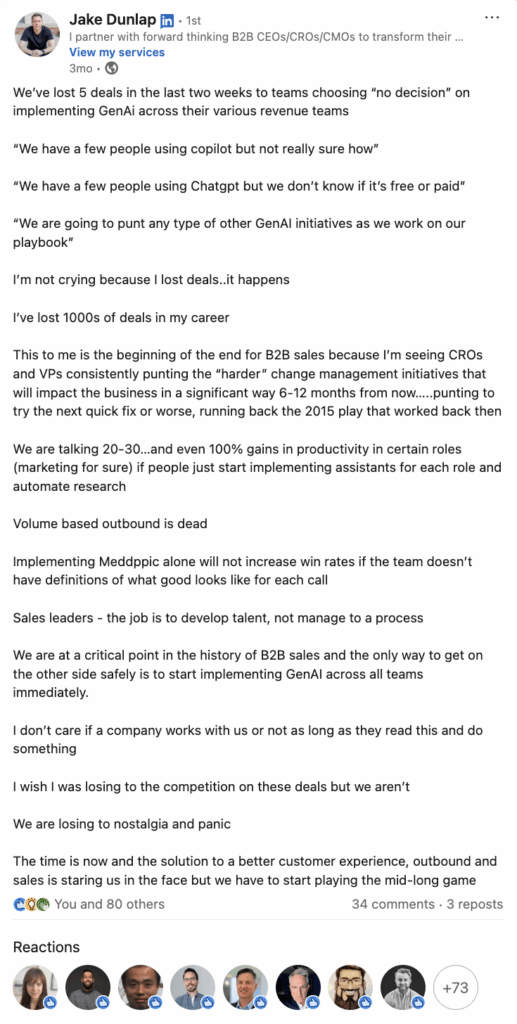
8) Losing to Nostalgia: GenAI and the B2B Sales Crisis
Deals are stalling as leaders choose “no decision” on GenAI due to change-management avoidance, despite 20–100% productivity upside from assistants and automated research. The warning: volume outbound is dead. Method changes without definitions of “what good looks like” won’t fix win rates.
Implications on the market:
- The competitive threat isn’t vendor X; it’s organizational inertia. Teams that operationalize GenAI (assistants, definitions, enablement) will compress cycles and improve conversion while others plateau.
- Expect stronger exec sponsorship and RACI for AI programs to overcome “pilot purgatory.”
Did this continue throughout 2025? Yes. Adoption rose, but many stalled.
- Adoption with gaps: HubSpot 2025 shows broad AI use but underscores training/process as the missing link for ROI. (HubSpot Blog)
- Enterprise value capture is scarce. BCG 2025: only ~5% achieve measurable outcomes, indicating widespread stagnation despite access to tools. (Business Insider)
Will this continue into 2026? Yes. But leaders will force the issue.
- 2026 CFO priorities (margin protection, mix optimization) mean pilot purgatory is a luxury most orgs can’t afford. AI programs with clear operating metrics (time saved, lift in conversion) will get funded; others will be cut. (Gartner)
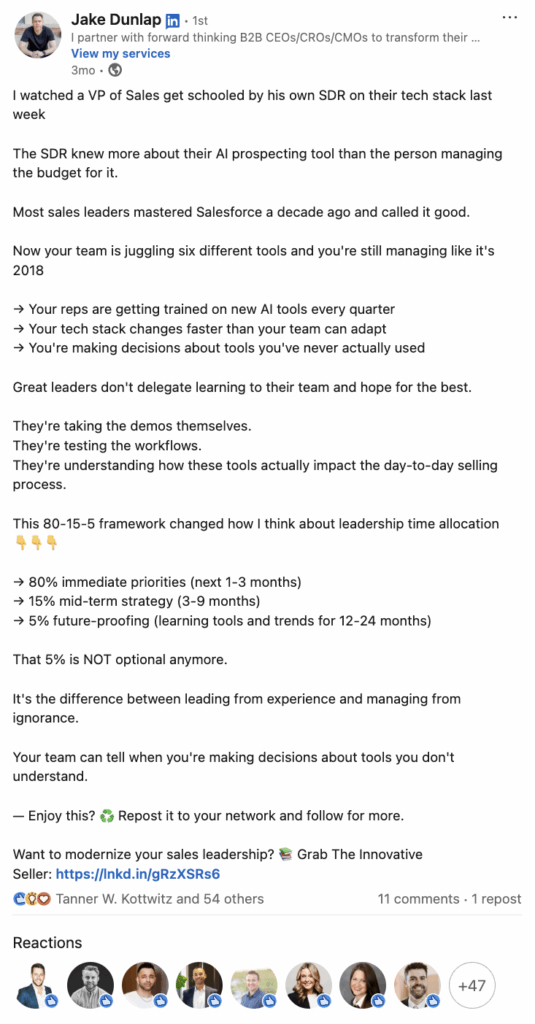
9) Execs Must Learn AI Tools Themselves
A VP of Sales was outpaced by an SDR on tool literacy, showing that senior leaders who don’t understand their tech stack risk losing credibility and effectiveness. Leadership must be hands-on with AI tools vs. just telling their team to use them.
Implications on the market:
- Leadership roles are evolving: future CROs/VPs need tech fluency.
- Enablement investments must include leadership development, not just training for reps.
- Tool adoption fails without executive sponsorship and understanding.
Did this continue throughout 2025? Yes.
- According to the “Top Sales Prospecting Trends to Know in 2025” by Outreach, 74% of sales teams now use technology to personalize and automate outreach. (Outreach)
- The same report notes that 29% of teams still have scattered views of their metrics, a leadership awareness gap. (Outreach)
Will this continue into 2026? Yes. Leadership tech literacy will become a baseline competency.
- As AI becomes more integrated into revenue operations, leaders who can’t speak fluently to workflows, metrics, and adoption will struggle for budget and being seen as relevant.
- Expect leadership KPIs to include “tool-adoption oversight” and “workflow integration” as opposed to purely quota-based evaluation.
Related Content:
27 Best AI Sales Tools for 2025
Outbound becomes a performance channel again
The evolution of outbound has been underway for years, but 2025 was the year it finally started to stick.
For a long time, the right direction was clear: less volume, more relevance; fewer touches, more intention. Skaled has been beating that drum for a while. This year, more teams finally started listening. Instead of doubling down on automation and activity metrics, leading sales orgs began treating outbound like a strategic lever, not just a numbers game.
That shift showed up in the move toward buyer psychology, curiosity gaps, async messaging, and warm-first outreach. And while not every team is there yet, the performance gap between those who made the shift and those who didn’t became impossible to ignore.
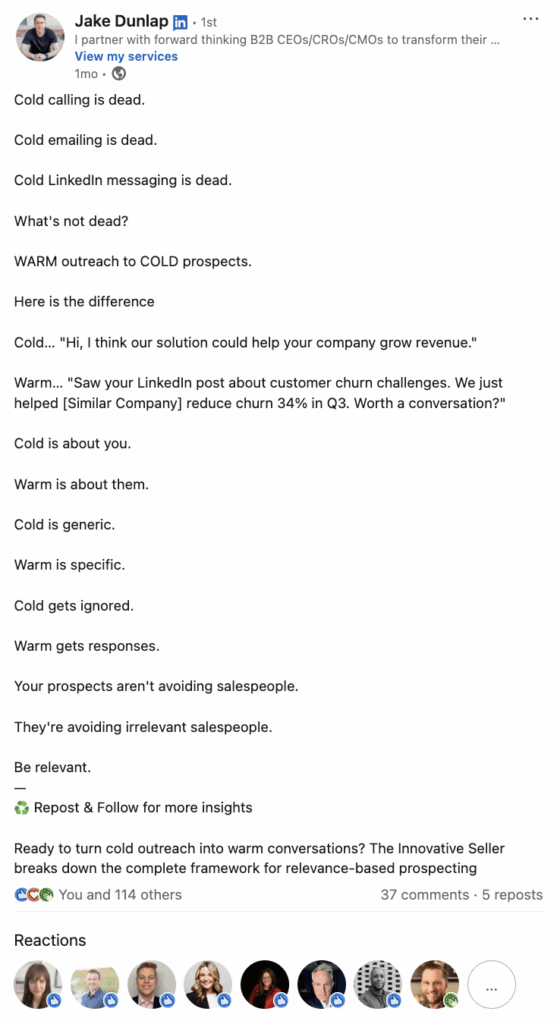
10) The Death of Cold Outreach (and Rise of Relevance)
The post asserts that cold calling, cold emailing, and generic LinkedIn outreach are no longer effective. Success in outbound now depends on relevance, from personalization to context, rather than volume.
Implications on the market:
- Sales orgs must shift from volume to precision.
- Tools and processes must support insight-driven segmentation and hyper-relevant messaging.
- Buyers expect outreach to reflect their business context, reducing tolerance for a generic sales pitch.
Did this continue throughout 2025? Yes.
- The Outreach 2025 prospecting report indicates heavy usage of technology for personalized outreach. (Outreach)
- A 2025 “7 Personalization Statistics” article notes rising expectations for personalization in business interactions. (Fast Simon Inc.)
Will this continue into 2026? Yes. And it will become more automated.
- With AI scaling personalization at speed, generic outreach will continue to underperform.
- Investment will shift toward dynamic personalization engines, predictive triggers, and buyer-context orchestration rather than broadly cast messages.
Related Content:
How to Prompt ChatGPT to Profile Your Prospects
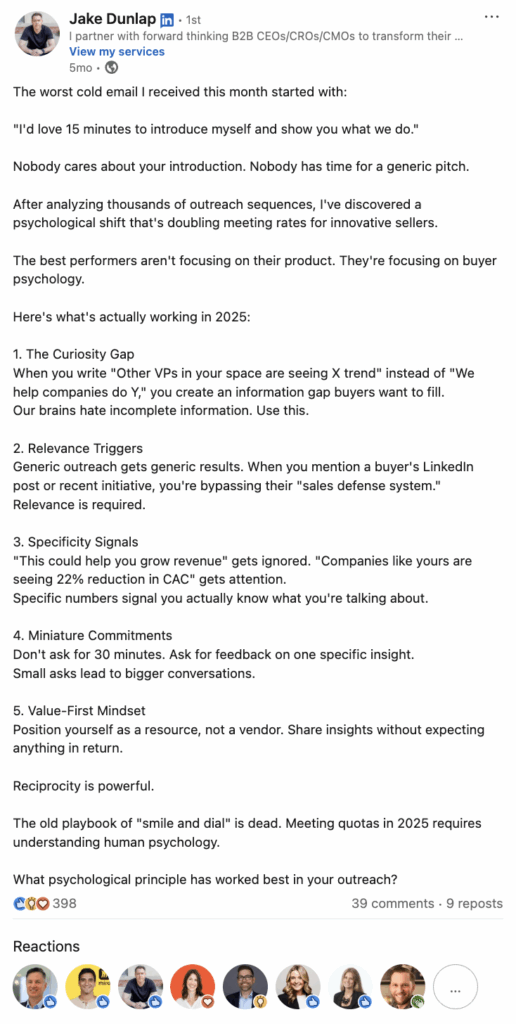
11) The Psychology of High-Performing Outreach
The post criticizes the old “I’d love 15 minutes to introduce myself” approach and argues that high-performing outreach uses behavioral science: curiosity, specificity, micro-commitments, and relevance.
Implications on the market:
- Sales training must incorporate behavioral science and buyer psychology modules.
- Messaging tools, sequences, and templates need to trigger interest, rather than just “book a meeting” tactics. Performance metrics will shift toward deeper engagement (e.g., reply quality, meeting conversion), not just opens or clicks.
Did this continue throughout 2025? Yes.
- Sales enablement trend commentary for 2025 emphasized micro-commitments and personalization. (joinpavilion.com)
- Also noted: AI and personalization tools are increasingly being used to optimize message framing and relevance. (SuperAGI)
Will this continue into 2026? Yes.
- As inboxes and content channels become more saturated due to AI efficiencies, personalized psychological differentiation will become more important.
- Outreach tools will integrate A/B behavioral testing, intent data, and micro-commitment triggers as standard. Sellers who ignore buyer psychology will lose the competitive edge.
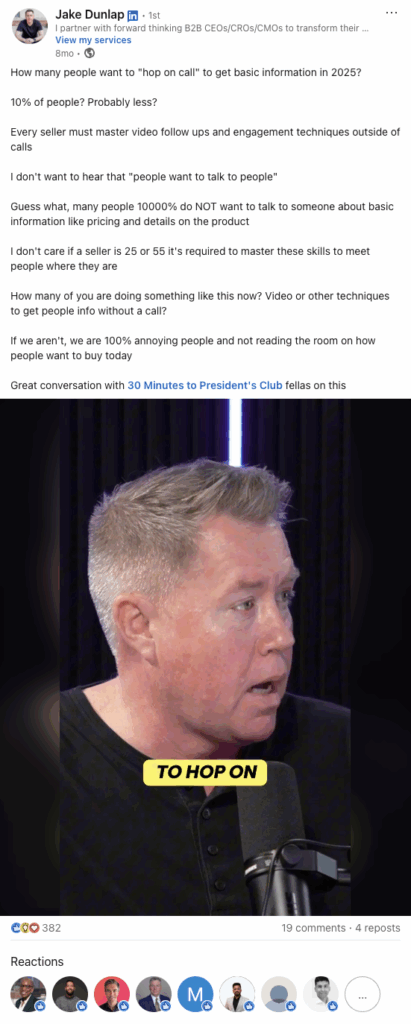
12) Buyers Don’t Want to Hop on a Call
Buyers increasingly prefer asynchronous, digital, self-service interactions for basic information. Asking for a call early creates friction. Instead, we should offer videos, self-guided content, chats, or digital experiences first.
Implications on the market:
- GTM models must expand beyond pitch-calls to digital buyer journeys built for self-service.
- Reps must be skilled not just at calls, but also at designing and supporting asynchronous interactions (video, chat, interactive content).
- Beyond call activity, performance management must include how well teams support digital touchpoints (content consumption, video engagement).
Did this continue throughout 2025? Yes.
- According to the “300+ Sales Statistics That Will Help You Sell More in 2025” list, 70–80% of B2B buyers prefer remote meetings or digital self-service over in-person meetings. (clevenio.com)
- Also, a report by McKinsey & Company shows digital buying channels growing in B2B, with remote/self-service spending rising significantly. (kensium.com)
Will this continue into 2026? Yes. Digital experience will be a differentiator.
- With buyer expectations now set for fast, digital, self-guided interactions, organizations that don’t refine their asynchronous buyer journeys will fall behind.
- Investment will lean into digital sales rooms, interactive content engines, and rep roles that become “digital journey engineers” rather than just call-closers.
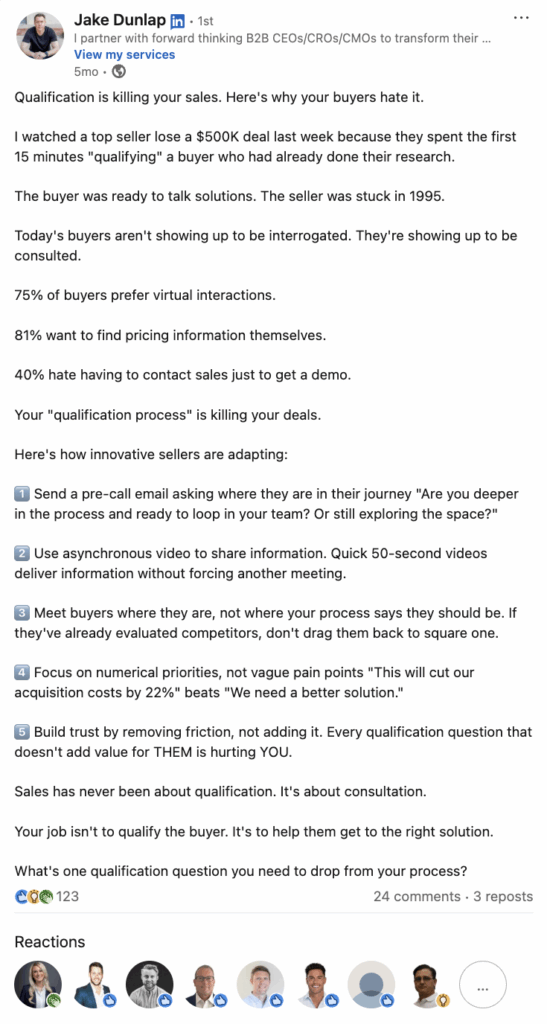
13) Sales Qualification Is Killing Your Deals
The post argues that rigid qualification frameworks (budget/timeline/authority) are frustrating buyers and preventing deals. Instead, sellers should focus on buyer initiative, alignment of solution to priority, and outcome-mapping.
Implications on the market:
- Qualification becomes a strategic conversation, not a checklist.
- Early in the process, enablement and methodology need to shift from gating to value alignment.
- Forecasting models must account for buyer priority and change risk, not just metrics.
Did this continue throughout 2025? Yes.
- According to HubSpot’s 2025 State of Sales Report, success is defined by revenue outcomes (ARR, win rate), not simply process adherence. (HubSpot Blog)
- Sales Pipeline Statistics 2025 shows an average win rate of 21%, suggesting that lots of deals still fail qualification early. (Sales So)
Will this continue into 2026? Yes.
- As sellers face longer cycles and tougher buyer scrutiny, qualification will increasingly be about initiative and priority, not simply fitting a template.
- Teams that adopt this shift will outperform peers with more efficient pipelines.
Related Content:
VECS: Identifying Vetted, Educated, and Cold Buyers
Sales process breaks away from frameworks and toward buyer alignment
2025 made one thing painfully clear: sales outcomes will continue to decline if teams don’t overhaul how they qualify, forecast, and guide deals.
Legacy frameworks and stage-based selling models that were once seen as foundational are now creating more friction than focus. Qualification, in particular, emerged as a critical failure point. Teams over-indexed on process and under-delivered on buyer alignment. The result? Longer sales cycles, lower win rates, and missed forecasts.
Some teams started to course-correct. They replaced mechanical qualification checklists with collaborative discovery. They began prioritizing buyer readiness over internal stage progression. They shifted forecasting inputs from opinions to observable signals.
But those were the exceptions, not the norm.
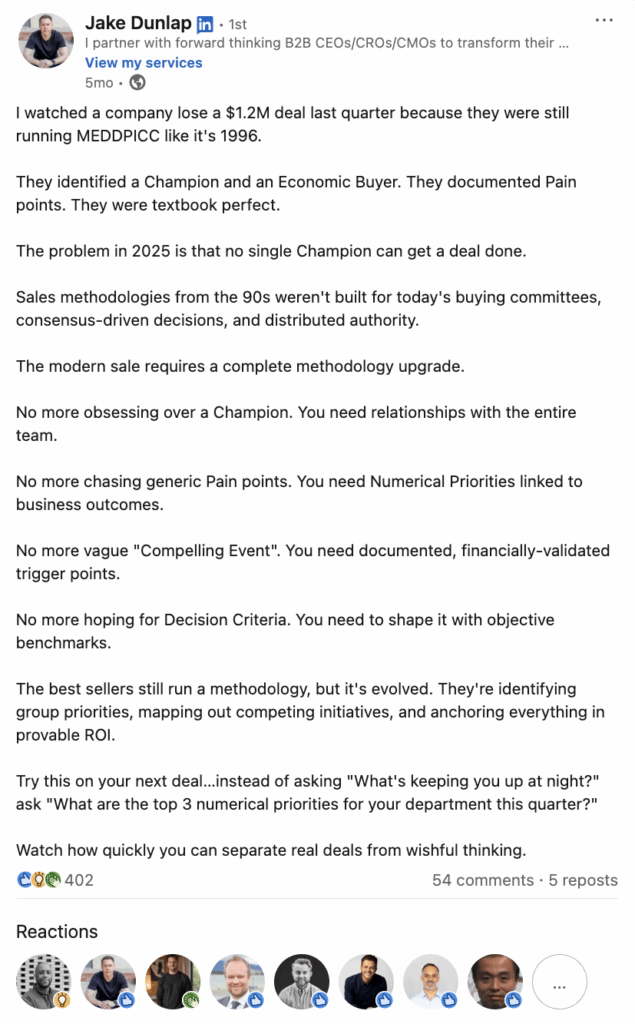
14) Our Sales Team Isn’t Bad at Closing. They’re Bad at Qualifying.
This post flips the narrative: closing isn’t the issue. The root cause is weak discovery and qualification (lack of buyer pain, initiative, and alignment). Without the right inputs, closing is just pushing harder.
Implications on the market:
- Coaching shouldn’t only be about closing scripts. It should focus on discovery skills and buyer initiative mapping.
- RevOps should restructure the funnel to front-load qualification and inject early value alignment.
Did this continue throughout 2025? Yes.
- 2025 data shows many sales professionals feel training and process are the major blockers: 28% say the sales process takes too long and is the reason prospects back out. (Vena Solutions)
- According to The Sales Collective, of the 66% of US sales leaders tailoring processes for B2B, 55% lost revenue due to the lack of a defined process. (The Sales Collective)
Will this continue into 2026? Yes.
- With increased competition and buyer sophistication, the quality of early-stage qualification will be a meaningful differentiator.
- Organizations will invest more in qualification tooling, buyer-initiative signals, and discovery frameworks.
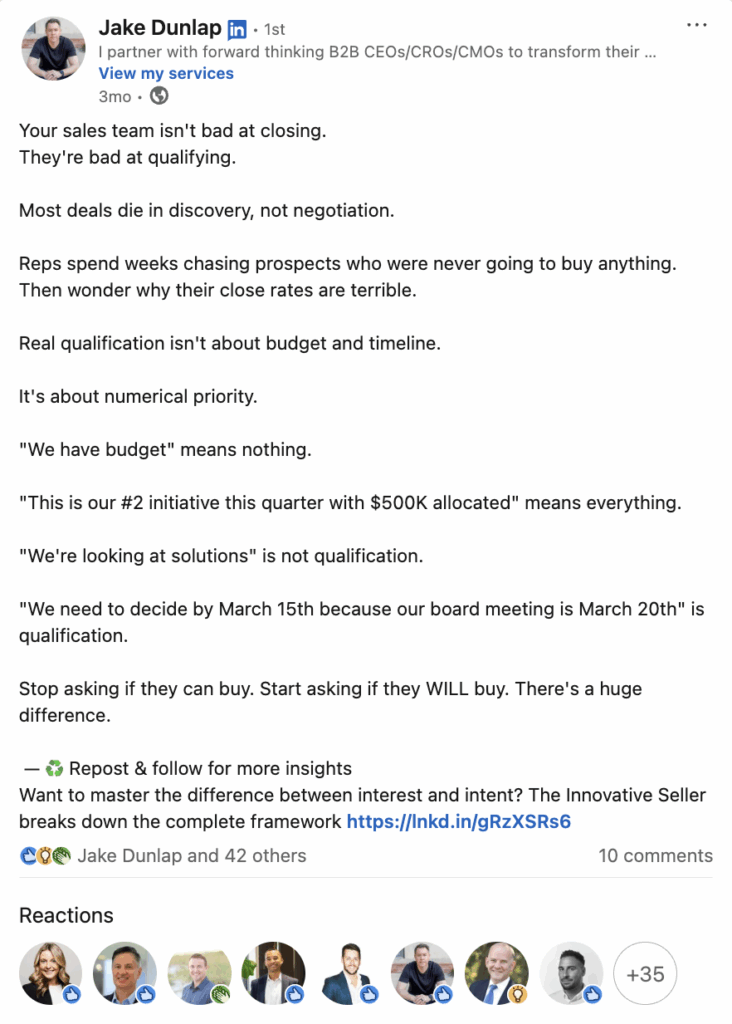
15) Stop Waiting for the Big Close
The post encourages sellers to break deals into micro-moments of yeses (small commitments, incremental value) rather than banking everything on one big closing event.
Implications on the market:
- Sales methodologies will shift away from a big close to mini-commitments, incremental validation, and reducing risk moments for buyers.
- Pipeline stages will be redesigned to track micro-yeses rather than just opportunity creation → close.
Did this continue throughout 2025? Yes.
- The Sales Process Statistics report shows 50% of high-performing teams measure process efficiency by conversion rates, not just closes. The focus is on incremental wins. (The Sales Collective)
- Companies that define a clear process grow revenue 18% faster, and optimizing pipeline management grew revenue 28% faster. (superoffice.com)
Will this continue into 2026? Yes.
- With longer cycles and more buyer touchpoints, the “big close” will be riskier. Sellers who create momentum through micro-closings will win more often.
- Methodologies and tooling that support tracking micro-yeses will be more in demand.
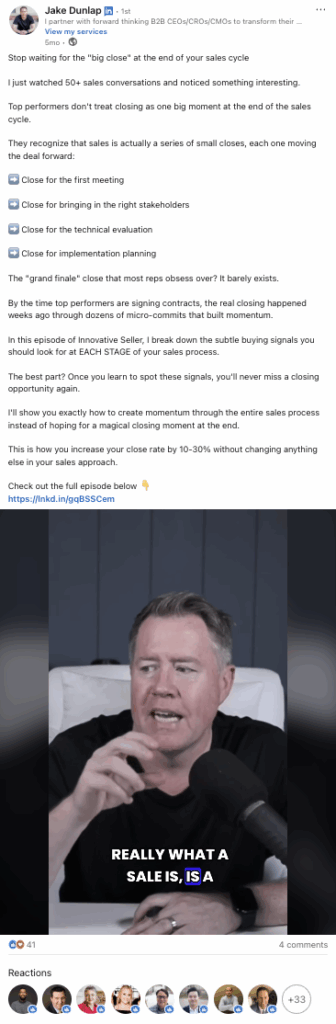
16) The Hidden Pipeline Killer: Competing Initiatives
Deals often stall not because of competitors, but because of internal buyer priorities, conflicting initiatives, or shifting company focus. Sellers need to map buyers’ corporate initiatives, not just the deal elements.
Implications on the market:
- Sales leaders must include time-frame risk, organizational priority mapping in qualification, and forecast modelling.
- RevOps must integrate initiatives that track opportunity scoring and pipeline engines.
Did this continue throughout 2025? Yes.
- According to VenaSolutions, 59% of business buyers aren’t satisfied with the efforts sales teams take to understand their goals. (Vena Solutions)
- The Sales Collective found that 55% of sales leaders lost revenue due to a lack of a defined sales process. The culprit? Misaligned processes and internal buyer risk. (The Sales Collective)
Will this continue into 2026? Yes.
- As organizations face more complexity and competing strategic initiatives (especially in tighter economic times), pipeline risk due to internal priorities will rise.
- Sellers and RevOps systems that incorporate initiative alignment, change-risk scoring, and multiparty stakeholder mapping will handle this better.
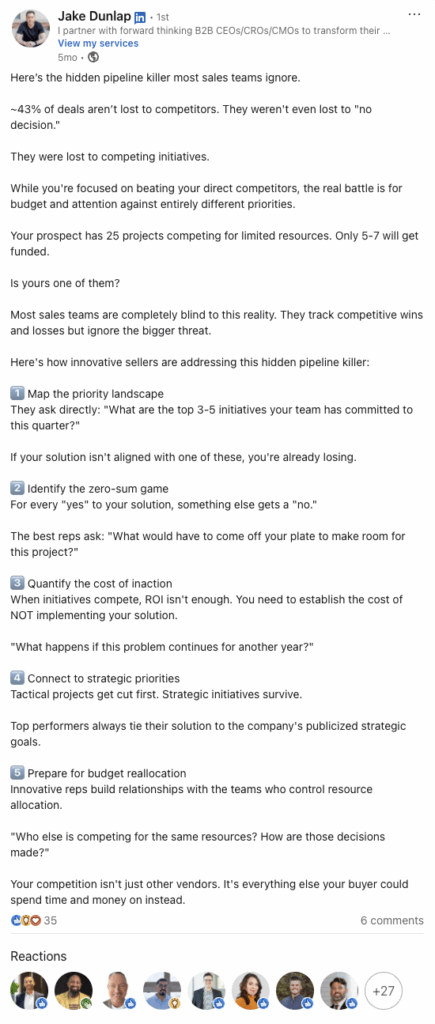
17) Old Methodologies Are Costing You Million-Dollar Deals
The post describes a lost $1.2M deal because the company used a legacy methodology (e.g., MEDDPICC) without updating it for modern buyer behaviour. The ask: modernize methodology to match modern buying groups, remote buying, and value-consulting.
Implications on the market:
- Sales methods must evolve. Frameworks built for simpler buying contexts won’t hold up in more complex, digital, multi-stakeholder sales.
- Enablement must refresh methodologies, embed value-and-outcome focus, and integrate AI-enabled analytics.
Did this continue throughout 2025? Yes.
- Outreach’s 2025 Data Report found that the majority of orgs reported win rates between 16% and 30%, with only 13% above 40%. (Outreach)
- The Sales Collective found that only 50% of leaders say high-performing teams measure efficiency via conversion rates, meaning many still rely on legacy metrics. (The Sales Collective)
Will this continue into 2026? Yes.
- Methodologies that don’t reflect buyer behaviors, decision-making complexity, AI-enabled outreach, and digital buyer journeys will become a liability.
- Organizations that evolve to a value-outcome methodology, integrate AI-enabled analytics, and consider digital buyer expectations will outperform.
Related Content:
Engineering Your Sales Process for Speed Using NTENT
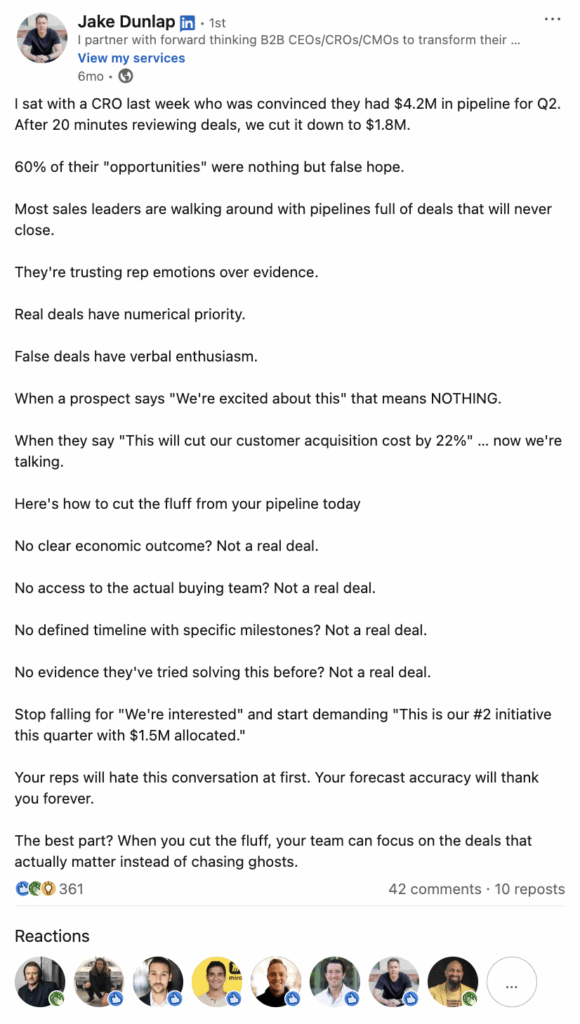
18) Cut the Fluff from Your Pipeline
This post highlights a CRO who was confident they had $4.2M in pipeline. However, much of it was just “interest,” not validated opportunities. The message: ditch the unqualified pipeline and adopt rigorous metrics and guardrails around what counts.
Implications on the market:
- Forecasting must pivot from “commit” rhetoric to validated opportunities based on initiative, budget, timeline, and outcome alignment.
- RevOps dashboards must reflect true pipeline health metrics (sales velocity, qualification rate, and risk grading), not just value.
Did this continue throughout 2025? Yes.
- According to HubSpot, 45% of professionals were overwhelmed by the number of tools in their tech stack, indicating pipeline measurement complexity. (HubSpot Blog)
- According to a Harvard Business Review study, 44% of executives think their organizations are ineffective at managing their sales opportunities, even though effective sales pipeline management can boost an organization’s growth rate by 15%. (Clari)
Will this continue into 2026? Yes.
- With economic pressure, senior management will scrutinize pipeline health more than ever, ignoring the KPIs that don’t align with reality.
- Tools and processes that provide real-time validated pipeline metrics, deal-risk scoring, and elimination of “false pipeline” will gain traction.
Sales hiring prioritizes character over credentials
Talent strategy evolved in 2025. The companies that keep hiring based on yesterday’s playbook will be outpaced by those building teams who are ready for what’s next.
As win rates dropped and productivity pressure increased, companies stopped chasing résumés and started looking for something harder to train: curiosity, grit, adaptability, and empathy. The traditional profile: SaaS experience, industry knowledge, and a quota badge didn’t guarantee results. In a year defined by rapid AI adoption and buyer behavior shifts, past experience often became a false signal.
Hiring managers began prioritizing coachability over credentials and character over career history. Instead of over-hiring, leadership started investing in the performance and enablement of smaller, sharper teams.
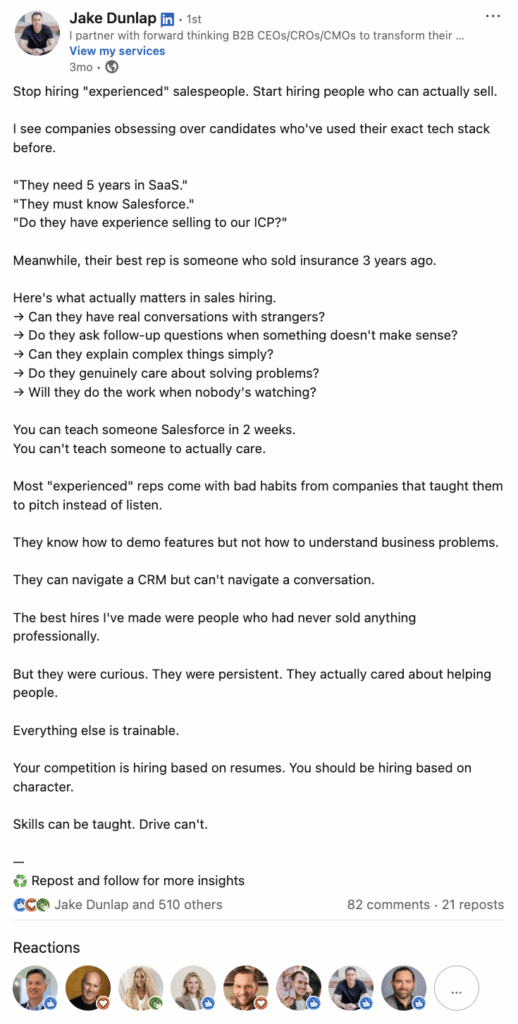
19) Stop Hiring Experienced Salespeople
The post argues that sales hiring should shift away from simply “experienced SaaS reps” and instead focus on reps who have the natural aptitudes and personality to sell. Instead of looking for a strong résumé with certain titles or X years or experience, sales orgs should look for people who can self-learn, are curious and adaptable, and who naturally align with your process.
Implications on the market:
- Talent strategy must pivot from “years in quota” to skill-based, behavior-based hiring (sales aptitude, coachability, process orientation).
- Enablement and onboarding programs become more critical: if hiring less “experienced” reps, you need strong ramp and support.
- RevOps and HR need to use assessments, structured interviews, and data-driven metrics to identify high-potential reps rather than relying on prior titles.
Did this continue throughout 2025? Yes.
- According to “Emerging Trends in SaaS Sales Hiring” (Hiredna, 2025), companies emphasized soft skills and adaptability more than pure years of experience. (HireDNA)
- Recruitment trends for 2025 emphasize skill-based hiring (Recruiterflow blog) over traditional credentials: “skill-based hiring will be a primary focus in 2025.” (Recruiterflow)
Will this continue into 2026? Yes. Strong likelihood.
- When growth slows and productivity matters more, organizations will prefer flexible, trainable reps over “experience” for its own sake.
- Hiring criteria will increasingly include data-backed indicators (learning agility, tool proficiency, behavioral fit), and less emphasis on “was at XYZ SaaS company for 5 years.”
- Companies less willing to invest heavily in headcount will favor high-potential hires + strong enablement.
Buyer models reset around psychology and precision
The traditional funnel continues to break down. MQL-SQL handoffs, static personas, and generic messaging underperformed across the board. In their place, a new model started gaining traction: GTM motions rooted in psychology, personalization, and precision.
AI played a major role, but a risky one. When used well, it allowed teams to build hyper-relevant, insight-driven experiences that respected the buyer’s context. But when used poorly, it amplified the problem: more noise, more automation, less connection. In 2025, that gap became impossible to ignore.
The teams that gained ground were the ones who treated AI as a tool for deeper empathy, not just speed. They aligned cross-functional teams around real buyer signals, not assumptions. And they reorganized workflows around how people actually research, evaluate, and commit.
20) AI, Buyer Psychology, and the New Buyer Model
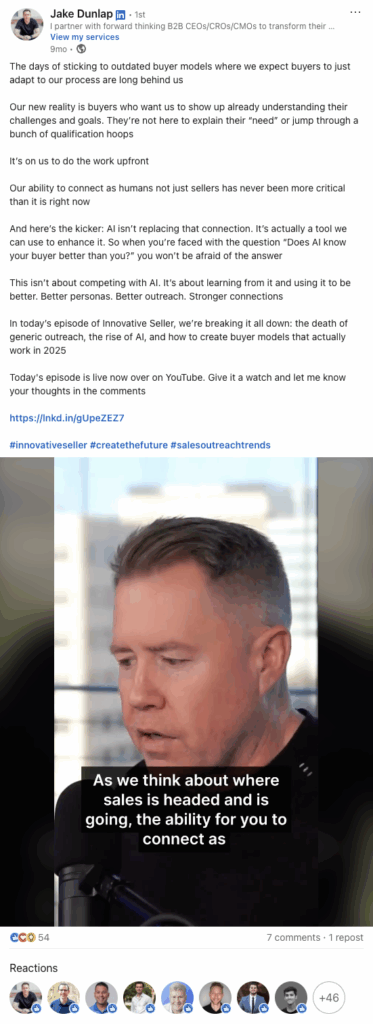
The post observes that the old buyer model, where sellers lead the process, has shifted. Today, buyers are more independent, use AI, rely on self-service, and expect sales to meet them at their initiative. Sellers must know buyer goals, use AI to engage, and adapt to the new buyer model rather than expecting buyers to adapt to theirs.
Implications on the market:
- GTM strategy must reflect a buyer-led model: sellers become guides, not just presenters.
- RevOps and Enablement must help teams shift from “pitching” to insight-driven engagement, leveraging AI for buyer research, personalization, and automation of self-service paths.
- Sales and marketing alignment must be tighter: buyers begin upstream, before sales show up. So, content, digital experience, and sales must integrate.
Did this continue throughout 2025? Yes.
- “B2B Buyer Behavior in 2025: 40 Stats and Five Hard Truths” highlights buyer independence, committee complexity, and early decisions. (Corporate Visions)
- “2025 B2B Buyer Behavior Report” analyzes millions of buyer interactions and shows digital/AI-led buyer behavior. (goconsensus.com)
- Ipsos’s “B2B 2025 Buyer Journey Trends” emphasises new tech (AI) and changing buyer dynamics. (Ipsos)
Will this continue into 2026? Yes. And it will likely accelerate.
- As AI and digital tools continue to empower buyers, the seller’s role bifurcates to early-stage self-service + late-stage human orchestration.
- Organizations that don’t adapt their buyer model risk falling behind as buyers go further independently before engaging sales.
- Expect investment in buyer-insight platforms, AI for early buyer engagement, and sales strategy that starts with buyer intent and research, not with outreach.
What GTM Leaders Should Do Now
After a year like 2025, it’s easy to feel like you’re falling behind.
Trends moved fast. Buyer behavior changed faster. And across RevOps, AI, outbound, and execution, the ground kept shifting under GTM teams trying to keep up. But it’s important to keep in mind that you don’t need to act on everything all at once. You just need to start with one clear end goal and work backward from there.
Chances are, in this article, we covered an exact friction point you’re experiencing. Whether it’s a misaligned process, outdated outreach, or teams struggling to adopt AI, the fix starts by asking: What outcome are we trying to drive? Then: What needs to change to get us there?
If you’re looking for momentum, here are three areas where leading teams are already moving:
1. Codify what works, and cut what doesn’t.
-
- Shrink your stack, simplify your process, and eliminate internal friction.
- Systematize repeatable success. Build around outcomes, not individuals.
2. Reskill your team for AI-native GTM.
-
- Turn AI from theory into workflow.
- Focus on enablement, adoption, and leadership fluency.
3. Rebuild outbound and buyer engagement around psychology.
-
- Stop playing the numbers game. Start getting strategic about timing, tone, and intent.
- Let data guide who you reach and how you show up.
If you’re ready to operationalize change, Skaled can help. From AI GTM enablement to fractional revenue leadership, we focus on what will help you move the needle.